With more than $40 trillion in capital projects expected globally over the next decade—more than $15 trillion in real estate and the remaining $25 trillion spanning transportation, energy, and communication—the need for efficient, scalable, and sustainable construction solutions has never been greater. In this expanding environment, regulators, developers, contractors, and other industry stakeholders cannot afford to overlook the transformative potential of modern methods of construction (MMCs). Identifying the right MMC technologies and integrating them effectively into new projects can be a game changer, significantly improving timelines, costs, and sustainability.
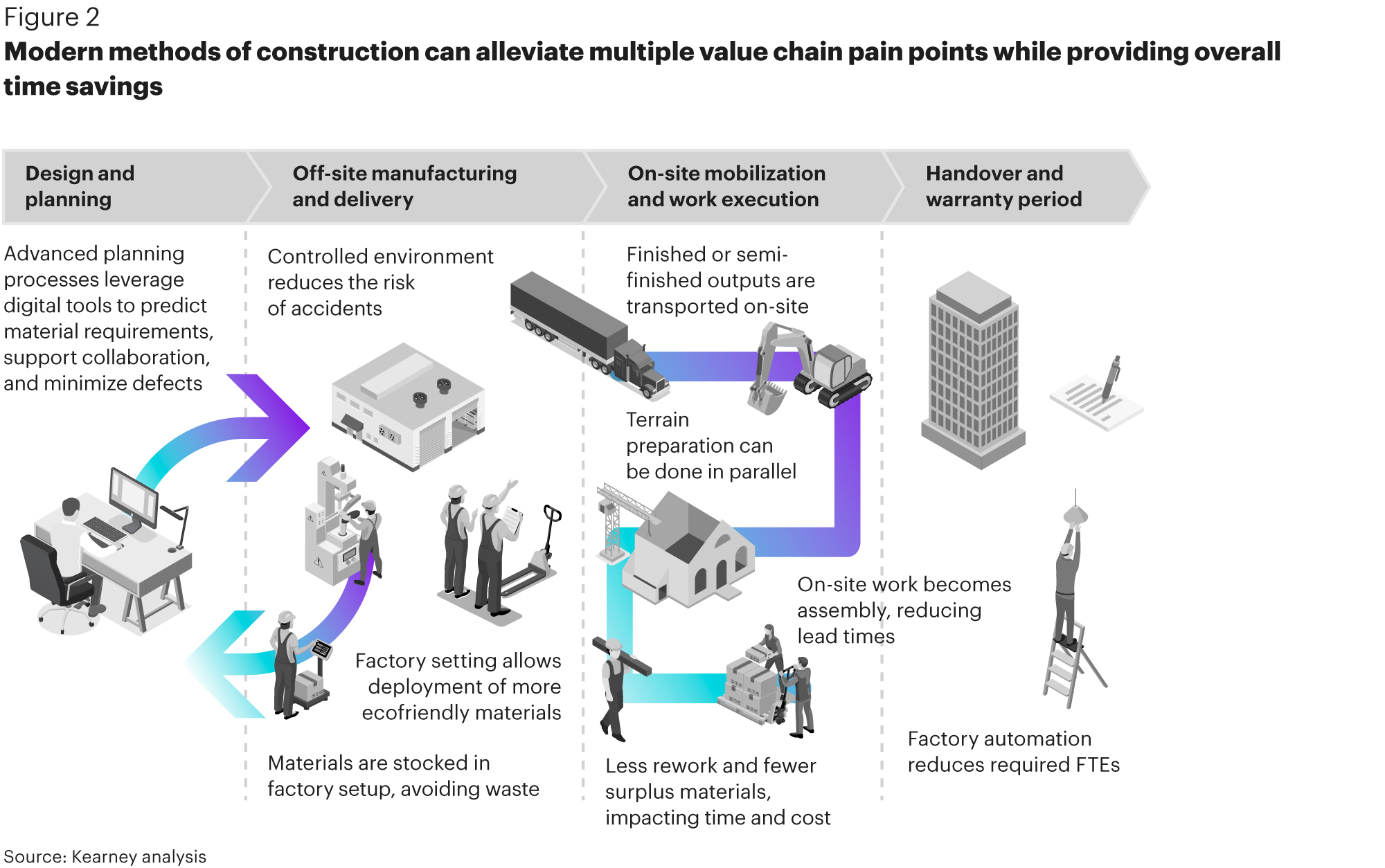
In Hong Kong, for example, the team of companies behind the InnoCell project at Science and Technology Park delivered a 17-story residential tower for tech professionals in only 14 months. They did so by prefabricating building modules off-site in a controlled factory environment—including finishes, fixtures, fittings, and even furniture—using modular integrated construction technology. They then transported these components to the construction site for rapid assembly. In parallel, they processed the on-site foundation work, significantly reducing the overall timeline.
Transitioning to MMCs has its challenges, including high initial costs and the industry’s reluctance to innovate. Such challenges can be overcome when industry players take a strategic approach that identifies the most suitable and relevant MMC technologies, suppliers, locations, and processes; creates long-term ecosystem partnerships; and builds proofs of concept (PoCs) that demonstrate the viability and benefits of modern methods of construction.
Why modern methods matter
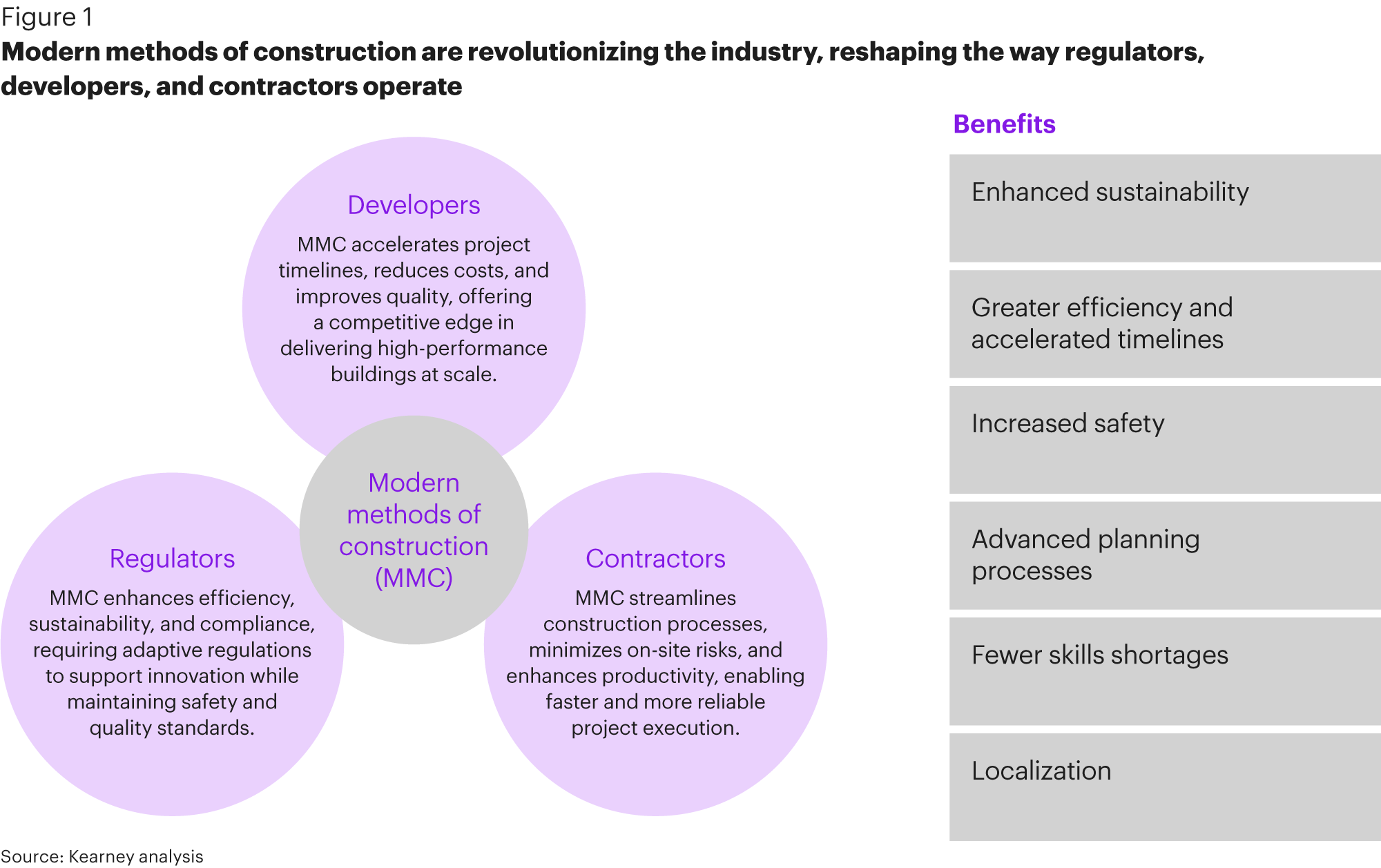
MMCs don’t just use modular building methods to shift infrastructure projects from traditional on-site construction to off-site manufacture and assembly. They also use 3D printing for components, such as foundations, floors, roofs, and panels. And they leverage off-site conditions and digital technologies to enhance design and planning, improve speed and efficiency, and ensure precision and quality while also reducing costs and waste, boosting sustainability, and improving safety (see figure 1).
To date, contractors and developers have typically used MMCs for real estate projects, such as residential houses and apartments, commercial buildings, hotels and restaurants, office buildings, and mixed-use construction. In Saudi Arabia, for example, the new smart city of Neom is embracing MMCs, including automation, prefabrication, and off-site manufacturing, to improve efficiency and reduce reliance on traditional labor-intensive construction methods. Neom is a testing ground for these innovations, including automating rebar manufacturing, which could reduce waste and improve safety.
MMCs bring a variety of benefits, including the following (see figure 2):
Enhanced sustainability. The construction industry is responsible for significant environmental impacts, including 40 percent of global carbon emissions and a third of the world’s water consumption and waste generation. Yet MMCs have significant environmental benefits, including waste reduction and the ability to use certain eco-friendly building materials. For example, off-site construction allows the use of some materials that cannot be deployed on a building site, such as engineered timber or recycled composites, which require precision crafting and strict environmental controls during production, as well as eco-friendly materials that degrade or fail if not handled carefully, such as geopolymer concrete or untreated bio-based materials. Neom, for example, is exploring advancements in modular and volumetric construction methods in part to address demand for sustainable materials, such as green steel and low-carbon cement.
In addition, MMCs use IoT sensors and AI to monitor energy consumption and environmental impact during the construction and operation of a building. And they significantly reduce the contractor’s carbon footprint by limiting on-site activities and transportation needs, given that fewer raw materials must be transported over long distances to building sites—whereas the factory can be built closer to the source. MMCs also require fewer materials in general, as it is easier to be precise in a controlled environment.
Greater efficiency and accelerated timelines. By building modular, prefabricated components or entire sections of buildings (volumetric construction) in a controlled factory setting, contractors and developers can accelerate construction timelines and increase efficiency. In our project experience, modular techniques have accelerated project timelines by 20 to 50 percent and reduced costs by up to 20 percent.
One way they save time is by avoiding weather delays and, as with the InnoCell project, allowing some parts of a building to be assembled while other on-site work is completed. For example, Factory OS was able to reduce costs by 30 percent over conventional construction projects and construction time from 18 months to just 10 months by using MMCs in a recent project in Vallejo, California. The model is now being replicated across the state to quickly provide more affordable housing.
In Saudi Arabia, Neom has already demonstrated the effectiveness of volumetric construction technology by building a residential community housing 3,000 people in just a year. This included a six-story building completed in 10 days, with a significant reduction in labor and time compared with traditional construction.
Another notable example is Clement Canopy in Singapore, a 40-story residential development that reduced traditional build times by 40 percent, according to our analysis. It did so by using prefinished, fully equipped modules that were assembled on site—streamlining the construction process significantly.
And in response to a growing demand for affordable housing, a public housing project in the UK pioneered the use of modular light-gauge steel (LGS) technology to construct modular homes for homeless families. These homes were manufactured off-site and transported for assembly, cutting construction time in half. In addition, this process reduced waste by 40 percent compared with traditional methods, highlighting MMCs’ environmental advantages.
Increased safety. With a larger portion of the construction work performed off-site in controlled environments, the risk of accidents and injuries is greatly reduced. In addition, MMCs include digital drones that can monitor on-site progress and identify hazards, along with AR and VR technologies that provide immersive safety training for workers without the on-site risk.
Advanced planning processes. MMCs use digital planning to boost efficiency, shorten project timelines, foster collaboration, and reduce design errors. Building information modeling, for example, creates a shared 3D representation of a project that integrates design, structural, and operational data. Digital twins—virtual versions of physical structures—analyze performance and minimize defects in the final project. And material optimization tools can accurately predict material requirements, reducing costs and waste due to over-ordering.
Fewer skill shortages. MMC alleviates the pressure of today’s skill shortages by shifting much of the work to factories, where automation and repeatable processes are more feasible. Based on our project experience, in fact, companies can reduce the number of FTEs required by up to 50 percent.
Localization
MMCs also contribute to any industry localization efforts. By shifting construction activities to factories near the construction site, MMCs help develop skilled local workforces and reduce the typical dependency on specialized foreign workers. Moreover, the adoption of MMCs encourages investment in local raw material suppliers, boosting economic growth and creating a more robust domestic supply chain. Governments that set local content requirements for construction projects can also use MMCs to meet and exceed these targets by fostering innovation in locally manufactured construction technologies and supporting in-country training programs.
In regions such as the Middle East, where governments are actively promoting localization through initiatives such as Saudi Arabia’s Vision 2030, an ambitious blueprint for bolstering and diversifying the Saudi economy, MMCs can be a key enabler in achieving this national objective by integrating local suppliers into modular construction processes.
The challenges of MMC
Despite the numerous benefits, MMCs pose several challenges. One significant challenge is the high initial investment cost of setting up and developing manufacturing facilities, technologies, processes, and supply chains, which can exceed the setup and preconstruction costs of traditional construction methods and create a financial barrier despite the long-term savings potential. In addition, the construction industry is traditionally slow to innovate, with reasons including its fragmentation, conservative nature, and tendency to focus on the short-term completion of current projects rather than long-term improvements or innovations.
Regulatory and compliance hurdles can also be a challenge, given that building codes and safety standards often lag technological advancements. And MMCs’ processes and materials may require additional inspections and certifications to comply with local building codes and regulations, such as both on site and at the factory rather than just on site. Meanwhile, adapting construction workflows to incorporate MMCs involves significant changes, including redesigning procurement, logistics, and on-site assembly processes. This integration can be complex and time-consuming.
Not surprisingly, then, although the technologies and processes behind MMCs have existed for some time, convincing stakeholders of the benefits often requires demonstrating tangible, proven outcomes.
A strategic approach to MMCs
Given these challenges, shifting to MMCs can require a substantial transformation. Nonetheless, the benefits greatly outweigh the drawbacks in terms of competitiveness, costs, timelines, safety, and environmental impact.
Suitable technologies. To begin, developers and contractors should analyze their project needs and take care to understand and identify the most suitable MMC technologies. Base decisions on project-specific requirements, scalability, and the anticipated impact on timelines and costs. Study the methods required for 3D printing, off-site modular and volumetric building, and precast columns (cast off site), along with other common MMCs such as insulated concrete forms, and modular LGS. Each offers unique advantages, including features such as enhanced thermal resistance, greater tensile strength, and faster construction times. Given the high initial investment, choosing the right technologies will be crucial.
Optimal suppliers. Researching and identifying the optimal suppliers for these technologies is a crucial step. Collaborating with global suppliers will help, giving greater access to high-quality materials and expertise. Engage with the construction ecosystem to create a robust network of support, actively collaborating with suppliers, manufacturers, clients, regulators, and competitors.
Ecosystem partners. Active collaboration can reduce costs, encourage the adoption of new technology, and reduce financial risk. It can also help contractors stay competitive, optimize their supply chains, and meet client demands more effectively. Forward-thinking players are building strategic partnerships with other ecosystem players, particularly their suppliers, focusing on long-term goals, mutual value creation, and shared risk reduction. For example, one international construction company partnered with an off-site manufacturer of modular units in the UK. The partnership allowed the two companies to complete the buildings for a specific project in just 12 months instead of the usual 24, while reducing costs by 20 percent.
Here’s how to develop effective partnerships:
- Identify mutual benefits. Highlight how working together closely can provide sustained value, such as cost savings, quality improvements, or faster delivery times.
- Offer joint problem solving. Tackle common challenges such as material sourcing or quality control together, opening the door for shared responsibility in innovation.
- Emphasize a long-term relationship. Shift from a transactional relationship to a strategic partnership by discussing growth opportunities, joint ventures, or repeat business.
- Establish clear communication. Regular meetings and transparency in goals can help move the partnership from one-off projects to collaboration for scaling MMC solutions.
Location and processes. Finding the best location for MMC infrastructure will also be crucial, especially in creating the right balance between regulatory environments. Contractors and developers will also need to adapt and integrate their processes—from engineering and procurement to supply chain and assembly—to align with MMC principles. Key considerations will include factory capacity, logistics, and automated production processes.
Proofs of concept. With the location chosen and specifics established, it’s time to develop PoCs that can demonstrate the viability and benefits of the chosen technologies, including MMC factories. PoCs will help validate the approach and let the business fine-tune the new processes before full-scale implementation. Note that developing PoCs doesn’t necessarily involve building full-scale factories up front, which could be prohibitive. Instead, the process typically relies on a combination of digital tools, scaled-down prototypes, and pilot projects to validate the approach before committing to full-scale implementation. For instance, before launching its major production facilities, Sekisui House, a leading modular builder, created pilot production lines to refine the company’s automated systems for panelized construction (prefabricating building components).
Implementation. Finally, full-scale implementation means rolling out MMCs across projects and ensuring continuous monitoring and optimization of each new process. It also requires training and capacity building, both essential for developing teams with the necessary skills and knowledge, including hands-on, technical training in digital tools, factory operations, and modular assembly. Upskilling both new and existing workers, using virtual and augmented reality simulations, and fostering collaboration across disciplines will also be essential. Partnerships with institutions for courses, leadership training, and pilot projects can ensure practical exposure, while ongoing certifications will keep teams updated on advancements, supporting long-term success in modular construction.
It's time to future-proof the industry
Forward-thinking developers and contractors are moving quickly to embrace the transformative power of modern construction methods, enhancing the efficiency, sustainability, and safety of their projects. We recommend connecting with industry leaders, exploring innovative MMC technologies, and joining the journey toward a resilient and future-proof construction industry.